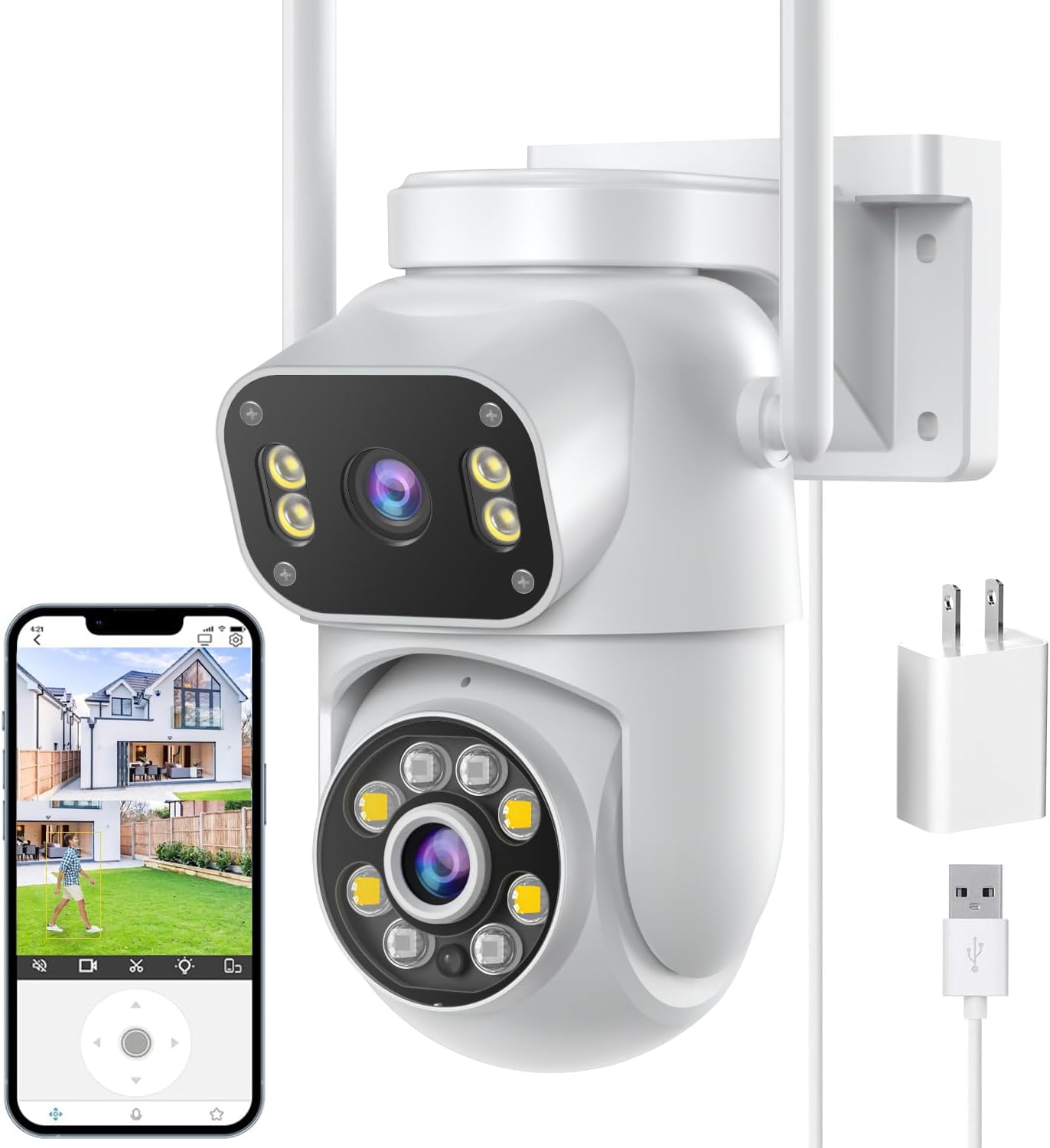
- 8MP 4K · 2 lenses
- Screws into an E27 light socket
- Runs on the iCSee app
The iCSee light bulb camera screws into a lamp fitting and takes its power from the socket, with two lenses on a turning head. Its base is E27, so a US home needs to check the fitting before it goes up.
Reviewed September 2026The iCSee bulb camera has an E27 base, the 27mm European thread; US and Canadian fixtures use E26, one millimetre narrower. It accepts AC 100–230V, so US mains voltage is within its range, and an E26-to-E27 socket adapter gives a proper fit. It is rated for indoor use, so outdoors it belongs only in a covered, enclosed porch fitting.
The iCSee bulb camera ships with an E27 base, the 27mm Edison screw used across Europe and much of Asia. US and Canadian fixtures take E26, a 26mm thread, so the question comes before anything else.
The two threads are close enough that an E27 base will often turn into an E26 socket. The fit is looser than either standard intends, though, and the centre contact may seat poorly, which is how flicker and heat start. For a device that stays on around the clock, fit it properly.
UK and Australian homes with B22 bayonet fittings face the same step with a B22-to-E27 adapter. Small E14 and E12 candelabra sockets cannot take it at all.
If adapters feel like one part too many, a bulb camera made with an E26 base, such as the Wyze Bulb Cam 2K, fits a US socket natively. It runs on the Wyze app, so it will not sit beside iCSee cameras in one device list.
| Base | Thread diameter | Standard in | Fits the iCSee bulb camera |
|---|---|---|---|
| E27 | 27 mm | Europe, much of Asia | Yes, its own base |
| E26 | 26 mm | US, Canada, Japan | With an E26-to-E27 adapter |
| B22 | 22 mm bayonet | UK, Australia | With a B22-to-E27 adapter |
| E14 | 14 mm | Small European lamps | No |
| E12 | 12 mm | US candelabra fittings | No |
E numbers give the Edison screw diameter in millimetres; B22 is a push-and-twist bayonet. Adapters add length, so check that the fitting has room below it.
The iCSee bulb camera is a full pan-tilt camera in a bulb-shaped body. Two lenses show on two screens in the app, and the head follows a person across the room.
The maker marks the dual-lens E27 bulb camera 8MP 4K, with a Sony CMOS sensor, H.265 recording and an 87° view per lens. It does not say how that 8MP divides between the two lenses, and on most dual-lens iCSee cameras the figure is a sum, so expect less than 4K in each view.
It is a camera first. The maker gives no lumen figure, so do not count on it to light a room; its lights serve colour night vision. Keep a separate lamp in the space if you need to see your way.
The box holds the camera and a manual. The rating is for indoor use, with an operating range of -10°C to 60°C.
4K Dual-Lens E27 Light Bulb Camera |
Wyze Bulb Cam 2K |
4MP Dual-Lens Pan-Tilt Camera |
BESDERSEC A6 1080p Pan-Tilt Camera | |
| Type | Bulb camera | Bulb camera | Multi-lens camera | Pan-tilt camera |
| Resolution | 8MP 4K | 2K | 4MP (2MP + 2MP) | 1080p (2MP) |
| Lenses | 2 lenses | 1 lens | 2 lenses | 1 lens |
| Pan & tilt | Yes | No | Yes | Yes |
| Power | E27 bulb socket | E26 bulb socket | Plug-in adapter | Plug-in adapter |
| Wi-Fi | 2.4GHz | 2.4GHz | 2.4GHz | 2.4GHz |
| Zoom | — | — | 4x digital | — |
| See this camera | See this camera | See this camera | See this camera |
Fitting takes a few minutes, and most of the work happens on the phone. Do the pairing with the camera in the socket you plan to use, because that is where its Wi-Fi signal will count.
A ceiling pendant hangs the camera upside down compared with a wall lamp. If the picture shows upside down, use the flip option in the camera's image settings, and set the pan limits so the head does not spend its time looking at the ceiling.
If pairing fails, bring the router closer or give the 2.4GHz band its own network name. A camera that was paired to someone else's account must be removed from it first; the reset steps show how to clear it.
Two lenses on a head that pans 355° and tilts 90°, powered by the light socket with no drilling or cable run. It pairs by Bluetooth and joins the same iCSee app as the rest of the house.
See this cameraA bulb camera only records while its socket has power. The switch that used to turn the lamp off now has to stay on, all day and all night.
This catches most households within a week. Someone flicks the switch on the way out, the camera goes dark, and the app shows it offline. Tape a cover over the switch, fit a switch guard, or move the camera to a socket nobody switches.
Enclosed glass globes cause two further problems. Heat from the camera builds up with nowhere to go, and the glass reflects the infrared LEDs back into the lens, washing out night footage. Open fittings, or globes removed altogether, give the clearest night picture.
Metal shades and thick fittings also weaken Wi-Fi. If live view stutters once the camera is in place, check the signal in the app and try the socket nearest the router. Persistent drops have their own list of fixes in the offline guide.
A bulb camera wins where a socket already sits in the right place and drilling is off the table, such as a rented flat or a hallway ceiling. Elsewhere, a conventional camera often does the job better.
Its strengths are simple. No drilling, no visible cable, and a height that already looks down on the room. Its limits come from the same socket: indoor rating, a switch that must stay on, and a fitting that may not point where you need.
Staying inside the iCSee app matters when other iCSee cameras already guard the house. One login shows the bulb beside the yard and garage cameras, and shared access works the same way for all of them.
Storage runs the same way too. The bulb camera records to its own microSD card, up to 128GB, so size it with the SD card guide, and remember that anyone who can unscrew the camera can take the card with it.
It has an E27 base, while US fixtures are E26. Fit it with an E26-to-E27 adapter; its AC 100–230V input already covers US mains voltage.
It is rated for indoor use. On a porch, use it only in a covered, enclosed fitting that keeps rain off, or choose an IP66 outdoor camera.
No lumen figure is given, and its lights serve night vision. Keep a normal lamp in the room if you need light.
Usually because the wall switch, a dimmer, a timer or a dusk sensor cuts the socket's power. Keep the circuit on at all times.
A printed manual comes in the box. Setup runs through the iCSee app: add the camera by Bluetooth or QR code on 2.4GHz Wi-Fi, then format the card.
Well-known cameras from neighbouring systems: a Wyze bulb with an E26 base, a Tapo pan-tilt dome, a solar 2-pack and a pet camera. Each runs on its own app (Wyze, Tapo, iCSee Home and others), so none of them joins the iCSee app next to your other cameras.