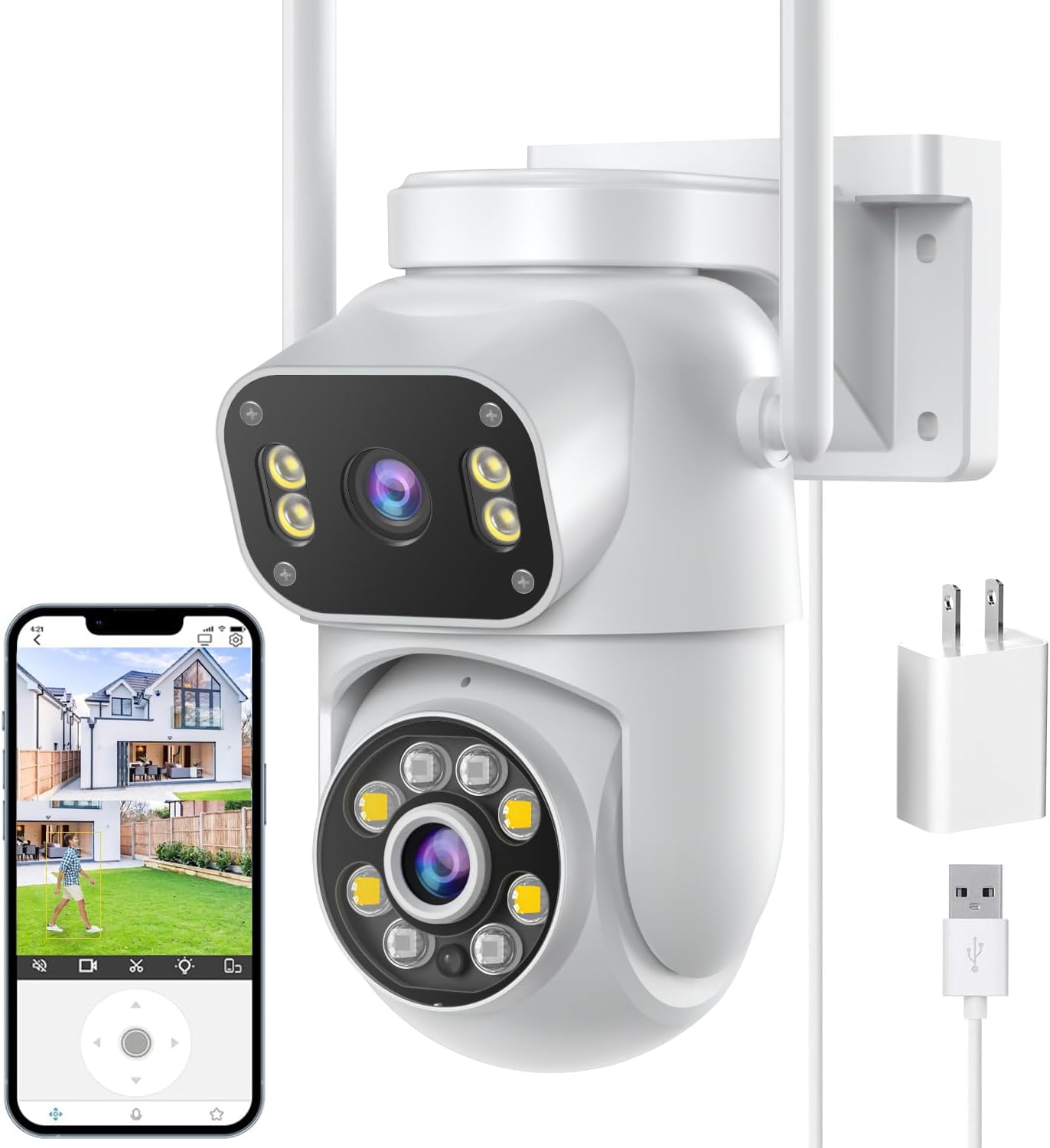
- 1080p (2MP) · 1 lens
- Pan & tilt from the app
- Runs on the iCSee app
An outdoor iCSee camera is chosen by how it gets power before anything else. A plug-in Wi-Fi dome, a PoE bullet on one cable and a solar dual-lens each fit a different wall, post or corner of the plot.
Reviewed September 2026Where an outdoor socket is within reach, a plug-in Wi-Fi pan-tilt such as the IP66 BESDERSEC A6 is the simplest route. Where the Wi-Fi is weak or the wall is far from the router, run one Ethernet cable to a PoE bullet like the IP67 HIKJBSET. Where no cable can go, the solar dual-lens runs on its panel and a 7800mAh battery.
“Wireless” on an outdoor iCSee camera means the video travels over Wi-Fi. A power cable still runs from the camera to an adapter, so the first job is finding a dry outlet within reach of the mount.
Most outdoor iCSee cameras are plug-in models. The adapter should sit indoors or in a weatherproof outdoor box, never loose on a wall, and the cable should pass through the wall in a sealed hole.
The A6 turns 355° and tilts 90° in an IP66 case rated from -4°F to 140°F. It records 1080p and talks to ONVIF recorders such as Blue Iris and ZoneMinder, though it has no web interface. A wide yard suits the SDTNOVA dual-lens, which adds a fixed view above the moving one.
Test the signal before drilling. Stand at the mount point with your phone on the same 2.4GHz network and watch a video. If it stalls there, it will stall on the camera, and the fixes in the offline guide or a PoE model are the way out.
| Camera | Power | Rating | Rated temperature | Night vision (maker figure) |
|---|---|---|---|---|
| BESDERSEC A6 | Plug-in adapter | IP66 | -4°F to 140°F | 4 IR + 4 white LEDs |
| SDTNOVA dual-lens | Plug-in, 2.4/5GHz Wi-Fi | IP66 | Not stated | Colour, about 10 m |
| GESKS 6MP dual-lens | Plug-in + Ethernet port | Waterproof | Not stated | Up to 65 ft |
| HIKJBSET 5MP bullet | PoE or 12V DC | IP67 | -4°F to 140°F | Up to 100 ft |
| Dual-lens PoE PTZ | PoE or DC 12V | IP66 | 14°F to 140°F | IR 30–40 m |
| 4K dual-screen PTZ | Plug-in adapter | IP66 | -4°F to 140°F | Colour and IR |
| Solar dual-lens | Solar + 7800mAh battery | Not stated | Not stated | Up to 30 m |
Ratings, temperature ranges and night distances as each maker states them. Night figures are best-case infrared reach; colour night vision with the white lights usually reaches less far.
Power over Ethernet sends power and video down one network cable, from a PoE switch, a PoE injector or a recorder with PoE ports. There is no adapter at the camera and no Wi-Fi link to drop.
The HIKJBSET 5MP bullet is the plainest outdoor iCSee camera to live with. It records 2880×1616 at 25fps through a 2.8mm, 108° lens, in a metal IP67 housing rated -4°F to 140°F, and a waterproof case ships alongside the screw kit.
The 4K PoE bullet family offers 4MP, 5MP or 8MP with a 2.8mm or 3.6mm lens and H.265 encoding. Its maker lists no card slot, so plan on an NVR or recorder to keep the footage.
Where a pan-tilt head should sit on the cable, the dual-lens PoE PTZ runs two 4MP lenses at a rated 3W and accepts DC 12V where no PoE source exists.
BESDERSEC A6 1080p Pan-Tilt Camera |
SDTNOVA Dual-Lens Linkage PTZ Camera |
HIKJBSET 5MP PoE Bullet Camera |
4K 8MP Dual-Lens PoE PTZ Camera |
4K Dual-Lens Solar Battery Camera |
GESKS 9MP 8x Zoom Triple-Lens Camera | |
| Type | Pan-tilt camera | Multi-lens camera | PoE camera | PoE camera | Solar camera | Multi-lens camera |
| Resolution | 1080p (2MP) | 6MP (3MP + 3MP) | 5MP | 8MP (4MP + 4MP) | 8MP (4MP + 4MP) | 9MP 4K |
| Lenses | 1 lens | 2 lenses | 1 lens | 2 lenses | 2 lenses | 3 lenses |
| Pan & tilt | Yes | Yes | No | Yes | Yes | Yes |
| Power | Plug-in adapter | Plug-in adapter | PoE (one cable) | PoE (one cable) | Solar + battery | Plug-in adapter |
| Wi-Fi | 2.4GHz | 2.4 + 5GHz | Wired only | Wired only | 2.4GHz | 2.4GHz |
| Ethernet port | — | — | Yes | Yes | — | Yes |
| Zoom | — | — | — | — | 5x digital | 8x |
| See this camera | See this camera | See this camera | See this camera | See this camera | See this camera |
A solar iCSee camera carries its own battery and a panel to refill it. It is the only kind that suits a gate, a shed or a field corner with no cable within reach.
The solar dual-lens pairs two 4MP lenses on a pan-tilt head with 5x digital zoom and a 7800mAh battery. It joins 2.4GHz Wi-Fi, records to a card of up to 128GB, and its black 8MP version comes with a 32GB card. The maker quotes night vision to 30 metres.
Read the standby claim with care. The maker quotes long standby, given in different places as 180 or 365 days, and standby means waiting, not recording. Every wake-up and every live view draws from the battery, and short winter days put less back.
No iCSee camera in this range takes a SIM card, so there is no 4G model. A site without internet needs a 4G router beside the camera, or a camera from a line built for cellular data. Battery cameras with no panel face the same limits and need regular charging.
One Ethernet cable carries power and 5MP video, so a wall far from the router records as steadily as one next to it. The metal IP67 housing and ONVIF support suit a camera that is meant to stay up for years.
See this cameraWater rarely gets in through a camera's housing. It gets in along the cable, through the joint where the camera lead meets the power or network cable, and through the hole drilled in the wall.
The IP rating tells you what the housing itself survives. IP66 means dust-tight and protected against powerful water jets; IP67 adds short immersion, down to one metre for half an hour. Most outdoor iCSee cameras are IP66, and the HIKJBSET bullet is IP67.
Temperature matters too. The A6, the HIKJBSET and the 4K dual-screen PTZ are rated down to -4°F; the dual-lens PoE PTZ and the 6MP 3-lens PTZ stop at 14°F. In a hard winter climate, pick from the first group.
Spider webs are the other outdoor enemy. Infrared light makes a web across the lens glow and set off motion alerts all night. A wipe with a soft cloth every few weeks, and a mount away from outdoor lamps that draw insects, keeps false alerts down.
A camera high on a gable sees the whole garden and nobody's face. Mount it where people must walk, at a height that catches them under a cap, and the footage becomes useful.
Around 2.5 to 3 metres is high enough to put a camera out of easy reach and low enough to see faces. Tilt it so the top of the frame just clears the horizon, and keep the sun out of the picture at dawn and dusk.
Night vision reach in the maker's figures assumes a clear, open scene. A white wall close to the lens reflects infrared back and darkens everything behind it, so leave space in front of the camera. Colour night mode, with the white lights on, also warns anyone approaching that the camera has seen them.
Point cameras at your own property. Set detection areas so a busy pavement does not trigger alerts, and keep neighbours' windows and gardens out of the frame. Once each camera is placed, pair and test it with the setup steps before the ladder goes back in the shed.
Most do: “wireless” means the video goes over Wi-Fi, but a cable still runs to an adapter. The exceptions are PoE cameras, powered through the network cable, and the solar model with its own battery.
The solar dual-lens runs on a 7800mAh battery topped up by its panel. Plan for less recording in dark winter weeks.
Not among these models: every one connects over Wi-Fi or Ethernet. A site without internet needs a 4G router next to the camera.
Both are dust-tight. IP66 resists strong water jets; IP67 also survives brief immersion, as deep as one metre, for no longer than 30 minutes.
Models with ONVIF, such as the BESDERSEC A6 and the HIKJBSET PoE bullet, record to most ONVIF recorders and NVR software.
A dome on a pan-tilt head covers a wide area and turns to follow people. A bullet points one way, suits a fixed view along a wall and is easier to aim precisely.