- 6MP (3MP + 3MP) · 2 lenses
- Pan & tilt from the app
- Wi-Fi 2.4 + 5GHz
Megapixels on an iCSee box are often a total across lenses, not a figure per view. Split the number by lens first, then match it to how far away a face or a plate will stand.
Reviewed September 20265MP in the iCSee range comes on wired PoE bullets, led by the HIKJBSET at 2880×1616; on Wi-Fi, the sharpest single view is the GESKS single-lens PTZ at 8MP 4K. Most “8MP” dual-lens models record 4MP per lens, and most “6MP” ones 3MP per lens. For a room, 1080p covers it; for a drive or a wide yard, go 4MP per lens or more.
On a two-lens body, the iCSee camera 8MP figure almost never means 8MP in either view. The number on the box adds the lenses together, and the detail you see in any one image comes from that lens alone.
Several makers spell the sum out. The 180° panoramic explains that its 8MP version pairs two 4MP lenses and its 4MP version two 2MP lenses. Others leave the split to the small print.
Two models are harder to read. The 4K dual-screen PTZ describes a 4K 8MP view beside a 4MP one, and one of its versions is sold as 6MP. The 10x dual-lens PTZ and the bulb camera quote 8MP across two lenses without a split.
None of this makes a dual-lens camera a poor choice. Two 4MP views of a yard, one wide and one following a person, often show more than one 8MP view that has to choose where to point. What changes is the distance at which each view can still pick out a face.
| Label on the box | Frame per view | Megapixels | Found on |
|---|---|---|---|
| 1080p | 1920×1080 | 2.1 | BESDERSEC A6, 1080p baby monitor |
| 3MP (2K) | 2304×1296 | 3.0 | SDTNOVA and GESKS 6MP, per lens |
| 4MP | 2560×1440 | 3.7 | 180° panoramic, solar, police-light PTZ, per lens |
| 5MP | 2880×1616 | 4.7 | HIKJBSET PoE bullet |
| 4K 8MP | 3840×2160 | 8.3 | GESKS single-lens PTZ |
Frame sizes are the usual ones for each label; the HIKJBSET figure is its own stated resolution. Individual cameras can use other frame shapes, so compare the megapixels per view.
Every 5MP iCSee camera in the range is a PoE bullet, powered and connected over one Ethernet cable. A search for a 5MP IP Wi-Fi iCSee camera ends here, because at 5MP the makers chose the cable.
There is a reason. A 5MP stream carries more data than a 1080p one, and a cable delivers it without the drops a crowded 2.4GHz band can cause. Every iCSee camera is an IP camera, but only the wired ones promise that link.
The 4K PoE bullet comes as a family of versions: 4MP, 5MP or 8MP sensors, each with a 2.8mm or 3.6mm lens. It encodes in H.265 and adds face detection. Pick the lens with the resolution: 2.8mm for a wide patio, 3.6mm for a narrower path where faces pass nearer the centre of the frame.
If the camera must be Wi-Fi, step sideways rather than up. The GESKS single-lens PTZ gives more pixels than 5MP on Wi-Fi, and its network port lets you add a cable later without replacing the camera.
BESDERSEC A6 1080p Pan-Tilt Camera |
SDTNOVA Dual-Lens Linkage PTZ Camera |
GESKS Single-Lens PTZ Camera |
HIKJBSET 5MP PoE Bullet Camera |
4K 180° Panoramic Dual-Lens Camera |
Three-Lens Three-Screen PTZ Camera | |
| Type | Pan-tilt camera | Multi-lens camera | Pan-tilt camera | PoE camera | Multi-lens camera | Multi-lens camera |
| Resolution | 1080p (2MP) | 6MP (3MP + 3MP) | 8MP 4K | 5MP | 8MP (4MP + 4MP) | 1MP per lens |
| Lenses | 1 lens | 2 lenses | 1 lens | 1 lens | 2 lenses | 3 lenses |
| Pan & tilt | Yes | Yes | Yes | No | — | Yes |
| Power | Plug-in adapter | Plug-in adapter | Plug-in adapter | PoE (one cable) | Plug-in adapter | Plug-in adapter |
| Wi-Fi | 2.4GHz | 2.4 + 5GHz | 2.4GHz | Wired only | 2.4GHz | 2.4GHz |
| Ethernet port | — | — | Yes | Yes | Yes | Yes |
| Zoom | — | — | — | — | 4x digital | — |
| See this camera | See this camera | See this camera | See this camera | See this camera | See this camera |
A true 4K camera records 3840×2160 on one lens, four times the pixels of 1080p. Of every kind of IP camera, 4K iCSee models ask the most of your Wi-Fi and your card, because those pixels have to cross one and fill the other.
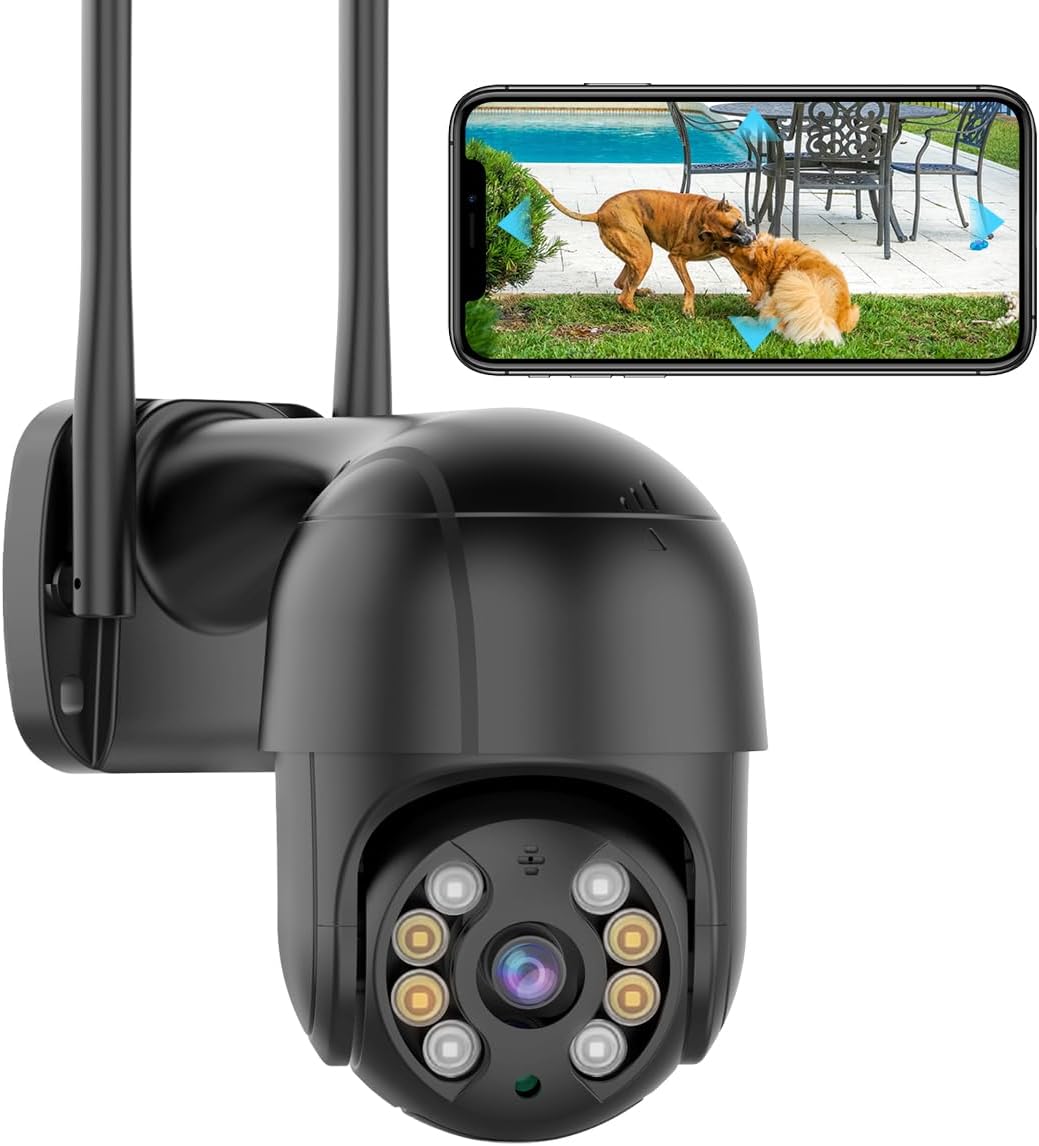
The GESKS single-lens PTZ is the clearest example. It records 8MP 4K at 24 frames per second in H.265, pans 355° and tilts 90°, and quotes night vision to 65 feet in colour or infrared. Its 3MP white version uses the same head for a smaller data load.
The 6MP 3-lens PTZ shows how the two streams differ in practice. Its main stream is 2304×2592 and its sub-stream 800×896, about a tenth of the pixels, which is what keeps live view quick on mobile data.
Where Wi-Fi already struggles, a higher label will make the picture worse, not better, because the camera drops frames to keep up. Fix the link first with the offline and signal fixes, then pick the resolution.
All eight megapixels sit behind one lens on a 355° pan and 90° tilt head, recorded in H.265 at 24 frames per second. An Ethernet port takes over when the Wi-Fi at the mount is thin.
See this cameraIndoors, faces are rarely more than a few metres from the lens, and 1080p puts enough pixels on them. The lower data rate also keeps live view smooth on a busy home network and stretches card space.
The BESDERSEC A6 records 1920×1080 on a pan-tilt head that turns 355° and tilts 90°. It carries four infrared and four white LEDs and talks both ways through the app. The 1080p baby monitor adds a 2.8-inch screen for video calls from the room itself.
Step up when the room is large or the camera watches through a window to the yard beyond. A 3MP or 4MP lens then keeps faces sharp further back. The Siosaxdot Q6 adds a second lens at 1080p class for a room with two doors.
Lower resolution also helps privacy in a small way. Footage that shows who is in a room, but not the papers on the table, is often all a home camera needs. Share it through the iCSee app rather than a shared login.
Resolution only matters in relation to distance and lens angle. Spread a frame's width across the scene in front of the camera, and what counts is how many pixels land on each metre of that scene.
The European standard for video surveillance, EN 62676-4, sets four levels: about 25 pixels per metre to detect a person, 62 to observe, 125 to recognise someone you know, and 250 to identify a stranger. Those figures turn resolution into distance.
| Width per view | Identify (250 px/m) up to | Recognise (125 px/m) up to |
|---|---|---|
| 1920 (1080p) | about 3.2 m | about 6.4 m |
| 2304 (3MP) | about 3.9 m | about 7.7 m |
| 2560 (4MP) | about 4.3 m | about 8.6 m |
| 2880 (5MP HIKJBSET) | about 4.8 m | about 9.7 m |
| 3840 (4K) | about 6.4 m | about 12.9 m |
These distances assume a 100° horizontal view, typical of a 2.8mm lens. A 3.6mm lens with a view near 85° pushes each distance out by roughly 30%, and optical zoom pushes it further still.
Night lowers every figure, because the sensor adds noise in the dark. Place the camera closer than the daylight numbers suggest, and let a light or colour night mode help.
The 5MP iCSee cameras are wired PoE bullets, such as the HIKJBSET at 2880×1616. On Wi-Fi, the GESKS single-lens PTZ records more, at 8MP 4K on one lens.
Only the single-lens models. On most dual-lens cameras 8MP means two 4MP lenses, and each view is 4MP.
Only when the 4MP sits behind one lens, at 2560×1440. The 4MP dual-lens pan-tilt splits it into two 2MP views, each close to 1080p.
For most rooms, yes. A face within about 3 metres of a 1080p camera with a wide lens is identifiable, and the smaller stream keeps live view smooth.
Yes. A 4K stream carries several times the data of 1080p, so the same card holds fewer days. H.265 encoding narrows the gap.
At 6 to 10 metres, a 4K lens or a 4MP lens with optical zoom recognises a person. Identifying a stranger at that range needs zoom or a closer camera.